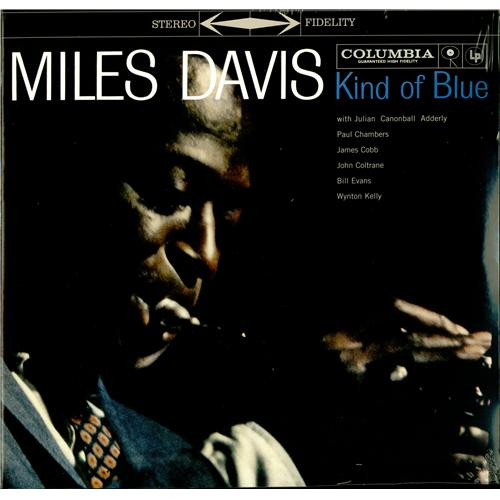
Marzo 1959. Il bebop ha già trasformato il jazz in un linguaggio ad alta densità: Charlie Parker e Dizzy Gillespie hanno dimostrato che la velocità può essere estetica, non solo virtuosismo. Miles Davis ha attraversato quella stagione e ne è uscito cercando altro. Con Birth of the Cool (1949–1950) aveva intuito il valore dell'essenziale; con Milestones (1958) aveva cominciato a sostituire l'armonia con il modo. Kind of Blue è il compimento di quella ricerca — e al tempo stesso la sua apertura definitiva. Dove Coltrane, nello stesso periodo, costruirà su Giant Steps un sistema armonico di claustrofobica complessità, Davis sceglie la direzione opposta: apre le pareti, lascia entrare l'aria, e affida a sei musicisti — Coltrane, Cannonball Adderley, Bill Evans, Paul Chambers, Jimmy Cobb — il compito di improvvisare su strutture modali che sembrano semplici e non lo sono affatto.
La seduta di registrazione dura un giorno e mezzo, tra marzo e aprile 1959, negli studi Columbia di New York. Davis porta i lead sheet agli strumentisti quella mattina stessa, senza prove. Il risultato è una musica che suona come se si stesse componendo nel momento in cui la si ascolta. So What apre il lato A con un tema affidato al contrabbasso di Chambers — la tromba di Davis entra dopo la risposta degli archi come se la musica esistesse già prima di lui, e lui stesse semplicemente decidendo se partecipare. Il fraseggio è rarefatto, ogni nota sospesa nel proprio spazio come se le alternative fossero infinite e tutte ugualmente valide. Blue in Green è il rovescio: tre minuti di piano e tromba con sordino in cui Evans e Davis costruiscono una fragilità così precisa da sembrare che possa interrompersi a ogni respiro. Flamenco Sketches chiude il disco con cinque scale modali affidate all'improvvisazione pura: non finisce — smette, semplicemente, di suonare.
Il pressing originale Columbia USA — etichetta a sei occhi, CL 1355 per il mono, CS 8163 per lo stereo — è il riferimento storico. La versione mono ha una presenza nei medi che lo stereo sacrifica in favore di una spazialità più aperta. Il riferimento moderno è la ristampa Mobile Fidelity MFSL 2-45011 in doppio 45RPM: master da nastro di generazione vicina all'originale, pressata RTI, con un soundstage che allarga la stanza e un silenzio di fondo quasi chirurgico. I transienti — gli attacchi della tromba, i tocchi di piatto di Cobb — hanno una definizione che su pressings più economici svanisce nella massa. La ristampa Columbia/Legacy 2015 su 180g è la scelta accessibile: onesta, con i bassi di Chambers che mantengono corpo e definizione anche a volumi alti.
Kind of Blue è il disco di jazz più venduto di sempre: un primato che altrove significherebbe sopravvalutazione. Qui significa che qualcosa nel modo in cui Davis ha organizzato lo spazio tra le note parla a chiunque abbia mai avuto voglia di ascoltare davvero. Il brano imperdibile è Flamenco Sketches: è lì che Davis mostra cosa significa avere il coraggio di non riempire. Certi dischi si consumano. Questo, ogni volta che lo si rimette sul piatto, sembra ancora da scoprire.
March 1959. Bebop has already transformed jazz into a high-density language — Charlie Parker and Dizzy Gillespie proved that speed could be an aesthetic choice, not merely a display of technique. Miles Davis had moved through that era and come out the other side looking for something else. Birth of the Cool (1949–1950) had already hinted at the value of restraint; Milestones (1958) had begun replacing harmonic complexity with modal scales. Kind of Blue is both the completion of that search and its definitive opening. Where Coltrane, in the same year, would build on Giant Steps a harmonic system of claustrophobic density, Davis chose the opposite direction: he opened the walls, let in the air, and handed six musicians — Coltrane, Cannonball Adderley, Bill Evans, Paul Chambers, Jimmy Cobb — the task of improvising over modal structures that appear simple and are anything but.
The recording sessions span a day and a half, March and April 1959, at Columbia's 30th Street Studio in New York. Davis handed out the lead sheets that same morning, with no rehearsals. The result is music that sounds like it's being composed in the moment of listening. So What opens Side A with a theme carried by Chambers' bass — Davis' trumpet enters after the ensemble's response as if the music already existed before him, and he was simply deciding whether to join. His phrasing is rarefied, each note suspended in its own space as though all alternatives were equally possible. Blue in Green offers the counterpoint: three minutes of muted trumpet and piano in which Evans and Davis build a fragility so precisely calibrated it seems it could stop at any breath. Flamenco Sketches closes the album with five modal scales given over to pure improvisation — it doesn't end. It simply stops sounding.
The original Columbia USA pressing — six-eye label, CL 1355 mono, CS 8163 stereo — remains the historical reference. The mono version carries a midrange presence that the stereo sacrifices for a more open soundstage. The modern benchmark is the Mobile Fidelity MFSL 2-45011 double 45RPM: mastered from a first-generation tape transfer, pressed at RTI, with a soundstage that expands the room and a noise floor that borders on surgical. The transients — trumpet attacks, Cobb's cymbal touches — carry a definition that on cheaper pressings simply dissolves into the mix. The Columbia/Legacy 2015 180g reissue is the accessible option: honest, with Chambers' bass maintaining body and clarity even at higher volumes.
Kind of Blue is the best-selling jazz album of all time — a distinction that in other cases would signal overestimation. Here it means that something in the way Davis organized the space between notes speaks to anyone who has ever truly wanted to listen. The essential track is Flamenco Sketches — that is where Davis shows what it means to have the courage not to fill the space. Some records wear out. This one, every time you put it back on the turntable, still seems like it has something left to reveal.
Il disco di jazz più venduto di sempre non è sopravvalutato: è semplicemente uno di quei rari oggetti sonori che parlano a chiunque voglia davvero ascoltare. Certi dischi si consumano. Questo, ogni volta che lo si rimette sul piatto, sembra ancora da scoprire.
The best-selling jazz album of all time is not overrated — it is simply one of those rare sonic objects that speaks to anyone who truly wants to listen. Some records wear out. This one, every time you put it back on the turntable, still seems like it has something left to reveal.